
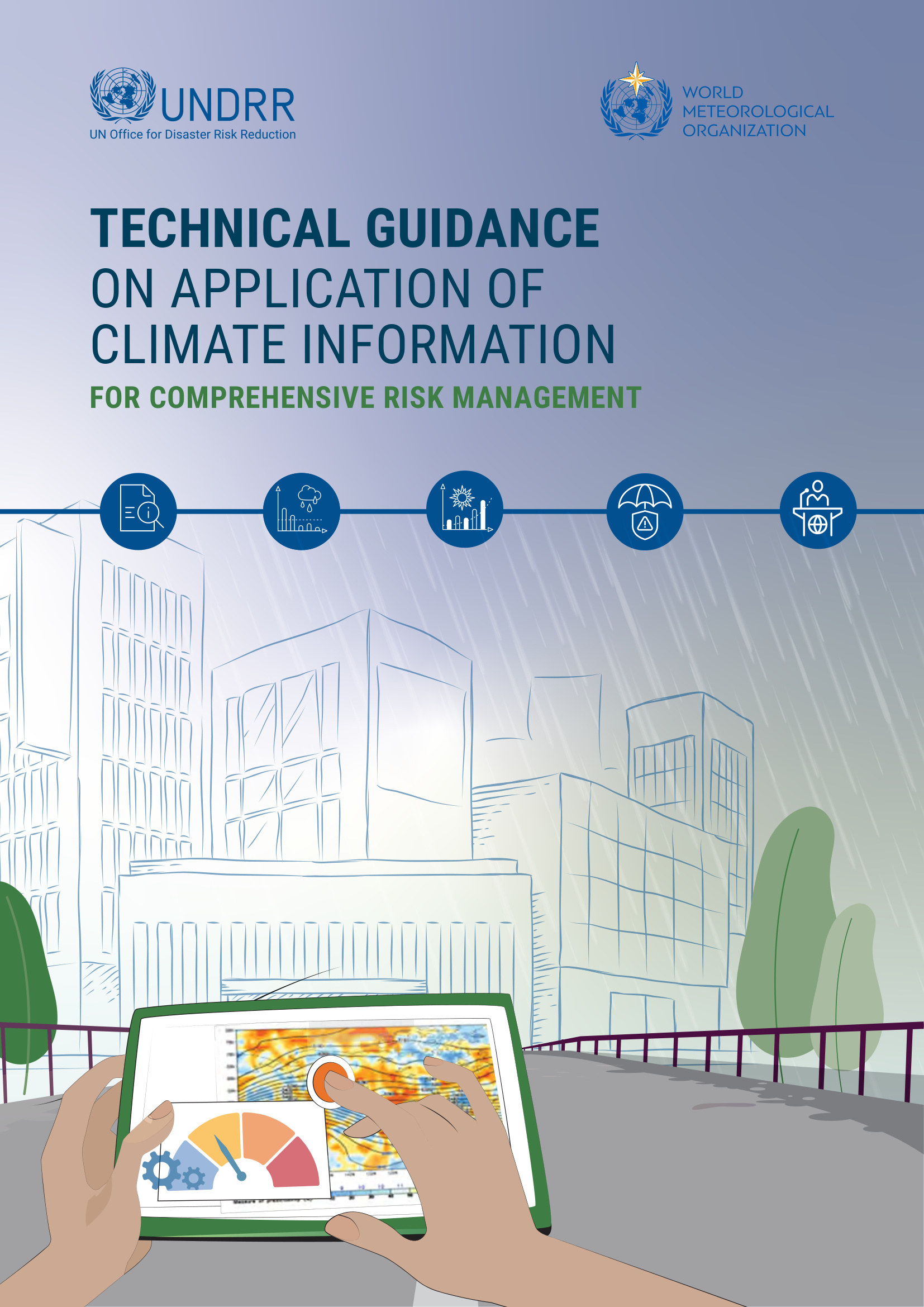
Floods, droughts, heatwaves, tropical cyclones — climate-related disasters are becoming more frequent and their impacts more severe. According to the latest IPCC reports, climate change is altering the frequency, intensity, and spatial extent of extreme events. The question is no longer whether we should prepare, but how.
A joint technical guidance published by the United Nations Office for Disaster Risk Reduction (UNDRR) and the World Meteorological Organization (WMO) offers a clear answer: if we want to effectively reduce risks, we must systematically integrate climate information into planning — from historical observations to future scenarios.
What is climate, and why does it matter?
Weather is what we experience today. Climate is what we expect — the long-term average of weather conditions at a given location. As Mark Twain reportedly put it: “Climate is what you expect; weather is what you get.”
For risk management, it is essential to understand so-called climate normals — average values of temperature, precipitation, and other variables over a 30-year reference period. These normals serve as a baseline against which we measure deviations. When a given year's temperature significantly exceeds the normal, we speak of a positive temperature anomaly — and such anomalies signal changing risk.
Climate indices: translating data into a common language
Raw temperature or rainfall figures can be hard for non-specialists to interpret. That is why scientists have developed climate indices — standardized indicators that express changes in extremes in a clear and comparable way. WMO has defined 27 core indices, including:
- number of hot days and warm nights,
- consecutive dry days,
- maximum one-day and five-day precipitation totals,
- number of heavy rainfall days.
These indices make it possible to compare trends across countries and regions and directly inform disaster risk reduction planning.
From global scenarios to local decisions
For the future, climate scenarios are key. The latest generation — Shared Socioeconomic Pathways (SSPs) — combine greenhouse gas emission projections with possible societal trajectories. For example, SSP1-1.9 assumes a shift towards sustainability and low emissions, while SSP5-8.5 envisions continued reliance on fossil fuels.
Importantly, these projections are not precise forecasts. They are “what if” scenarios that illustrate a range of possible futures. The longer the time horizon, the greater the uncertainty. That is exactly why planners need to work with multiple scenarios simultaneously and build flexibility into their strategies.
Putting it all together: 4 steps to an integrated plan
1. Take stock of what exists. What climate data and information are available? What disaster risk reduction and climate change adaptation plans and strategies are already in place?
2. Understand the risk. Analyse how risk is evolving due to climate change. Combine historical impact data with projections of future change. Account for vulnerability and exposure of populations.
3. Identify the gaps. Are there missing data? Capacity shortfalls? Financial constraints? Poor coordination between institutions? Naming the gaps is the first step towards closing them.
4. Produce an integrated plan. Bridge disaster risk reduction and climate change adaptation strategies. Establish monitoring frameworks, communication channels, and financing mechanisms.
Why this matters now
The UN's “Early Warnings for All” initiative, launched in 2022, aims to ensure that by 2027 every person on the planet is protected by an early warning system. Achieving this requires high-quality climate data, properly defined thresholds, and effective links between science and decision-making.
Climate change is not just an environmental issue. It is a matter of safety, economics, and everyday life. Climate information is one of the most powerful tools we have to anticipate and reduce risks — if we learn to use it.
Based on: UNDRR and WMO (2023), Technical guidance on application of climate information for comprehensive risk management. Available under CC BY-NC 3.0 IGO licence.