
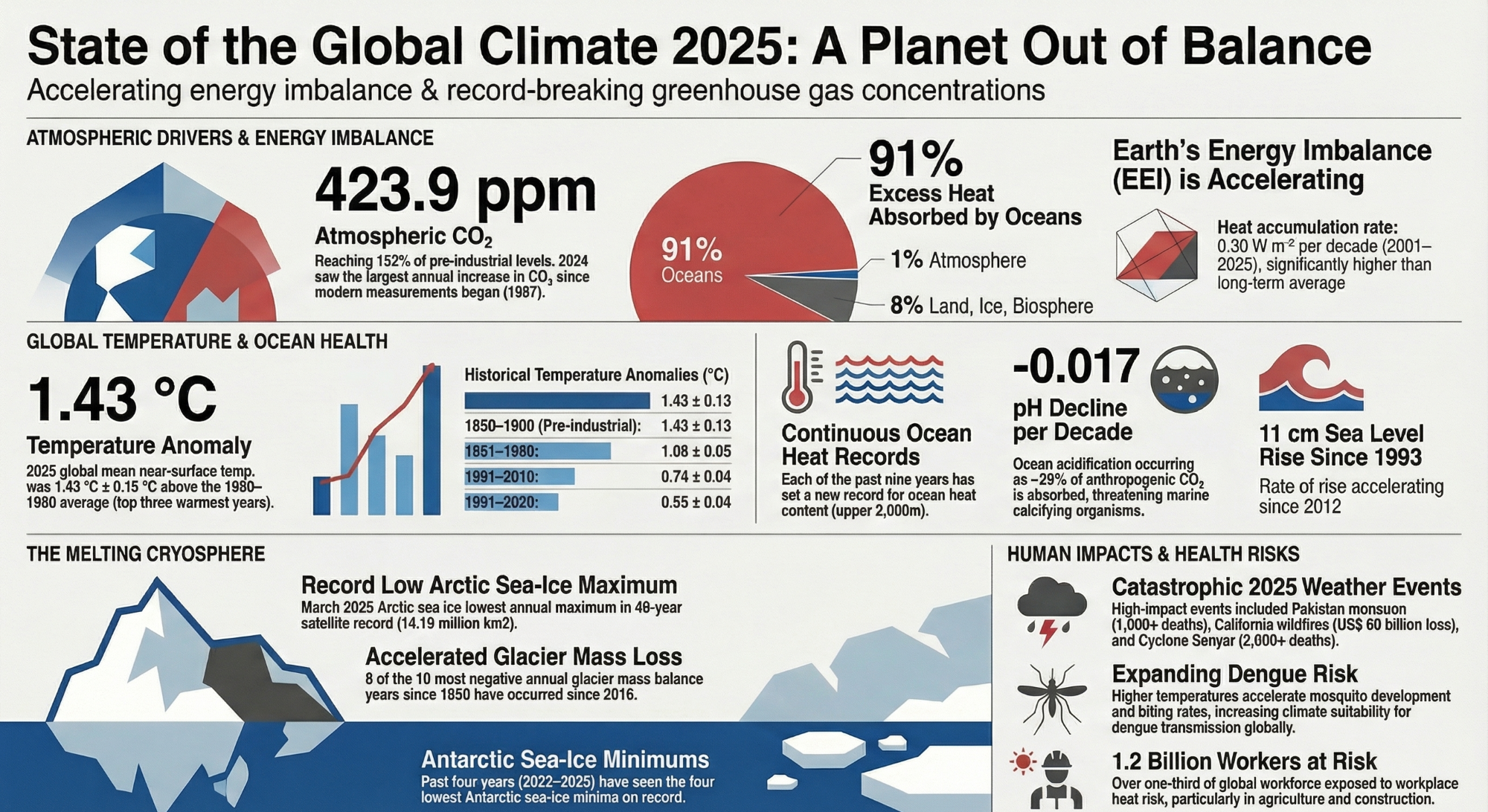
The World Meteorological Organization (WMO) released its annual State of the Global Climate report in 2026, covering the year 2025. The findings confirm a troubling trajectory: our planet is warming faster than at any time in the instrumental record, and the heat accumulated in the climate system has reached unprecedented levels.
Greenhouse gases: record after record
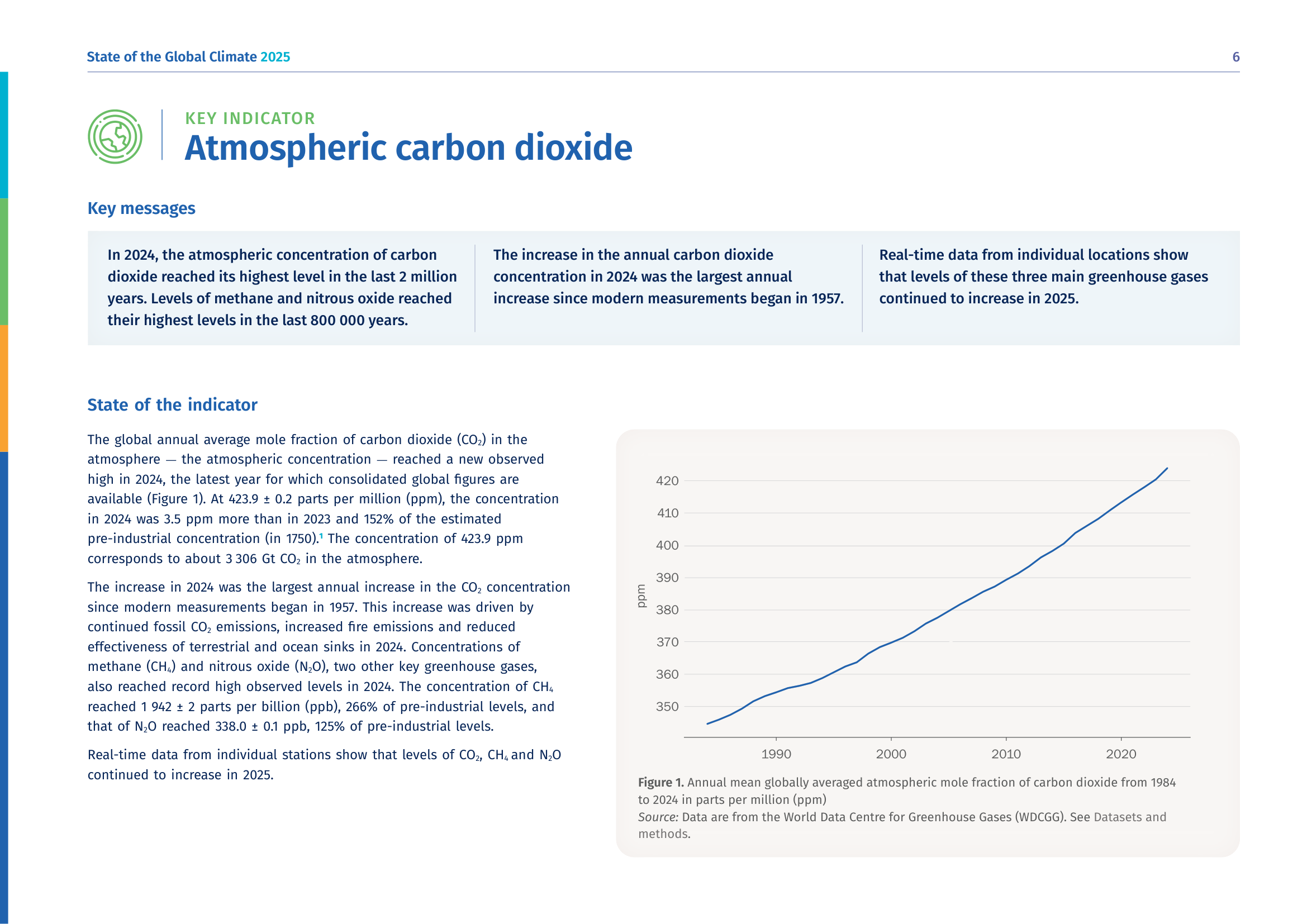
The atmospheric concentration of carbon dioxide (CO2) reached 423.9 ppm in 2024 (the latest year with consolidated global data) — the highest level in 2 million years. The year-on-year increase of 3.5 ppm was the largest since modern measurements began in 1957. The drivers included continued fossil fuel emissions, increased fire emissions and weakened natural sinks. Methane and nitrous oxide also hit record highs.
Real-time data from individual stations confirm that concentrations continued to rise through 2025.
Temperature: 2025 was the 2nd or 3rd warmest year on record
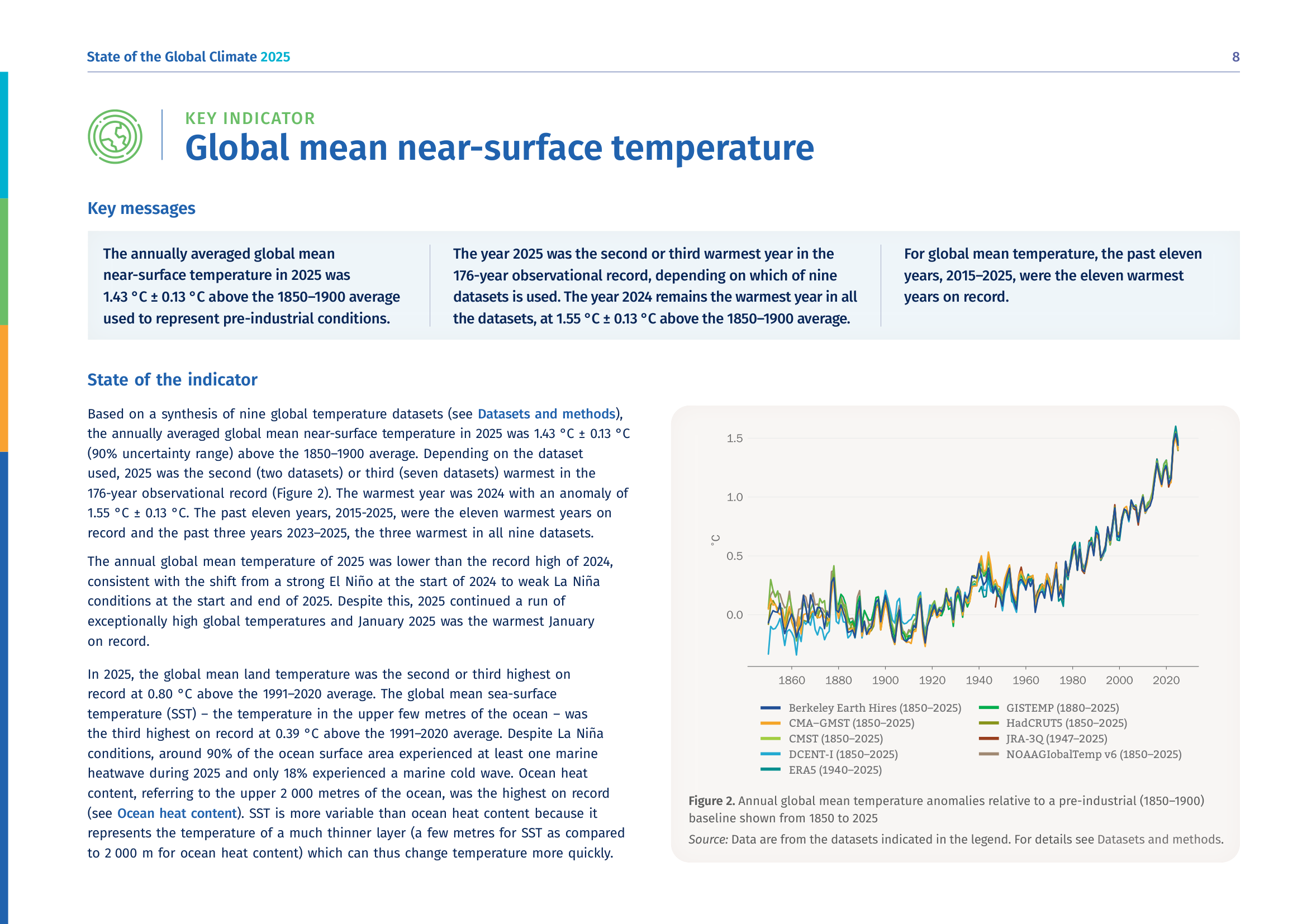
The global mean near-surface temperature in 2025 was 1.43 °C above the 1850–1900 pre-industrial average. Depending on the dataset, 2025 ranked as the second or third warmest year in the 176-year observational record — just behind the record-breaking 2024 (1.55 °C). The past eleven years (2015–2025) were the eleven warmest on record.
Remarkably, 2025 was the warmest year without El Niño conditions ever recorded. Although the shift to La Niña brought temperatures slightly below 2024, the anomaly remained well above any pre-2023 year.
Explore the data interactively
View monthly global temperature anomalies from 1880 to present in our interactive GISTEMP chart — with running means, decadal averages, warming stripes, and Paris Agreement thresholds.
Oceans: absorbing 91% of the excess heat
This year's report introduces a new key indicator — Earth's Energy Imbalance (EEI). The planet is receiving more energy than it radiates back to space. Where does the surplus go?
- 91% absorbed by the oceans
- 5% warms the land
- 3% melts ice
- 1% warms the atmosphere
Ocean heat content (upper 2,000 m) reached a new record in 2025 — the ninth consecutive year of records. The rate of ocean warming over the past two decades is more than double that of the 1960–2005 period. Meanwhile, the ocean has absorbed 29% of anthropogenic CO2 emissions, leading to acidification — surface pH is declining at a rate of 0.017 per decade.
The cryosphere: ice losses at a record pace
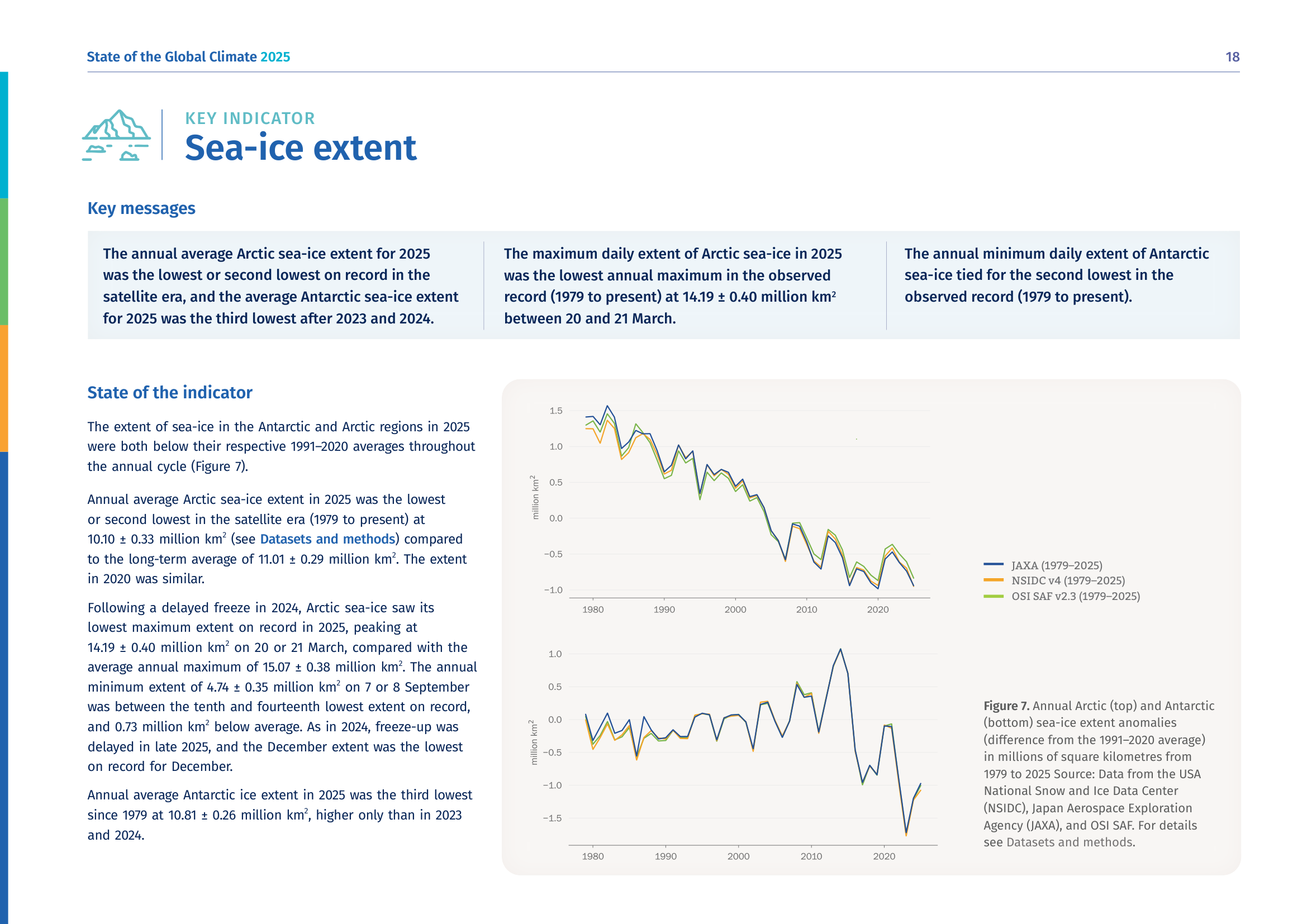
- Arctic sea ice reached its lowest maximum extent in the satellite era in March 2025 — just 14.19 million km².
- Antarctic sea ice: the past four years have seen the four lowest minima on record.
- Glaciers: 8 of the 10 most negative annual mass balances since 1950 have occurred since 2016. Exceptional losses were recorded in Iceland and along the Pacific coast of North America.
- Global mean sea level has risen by 11 cm since 1993, with the rate nearly doubling since 2012.
Extreme events: from California to Pakistan
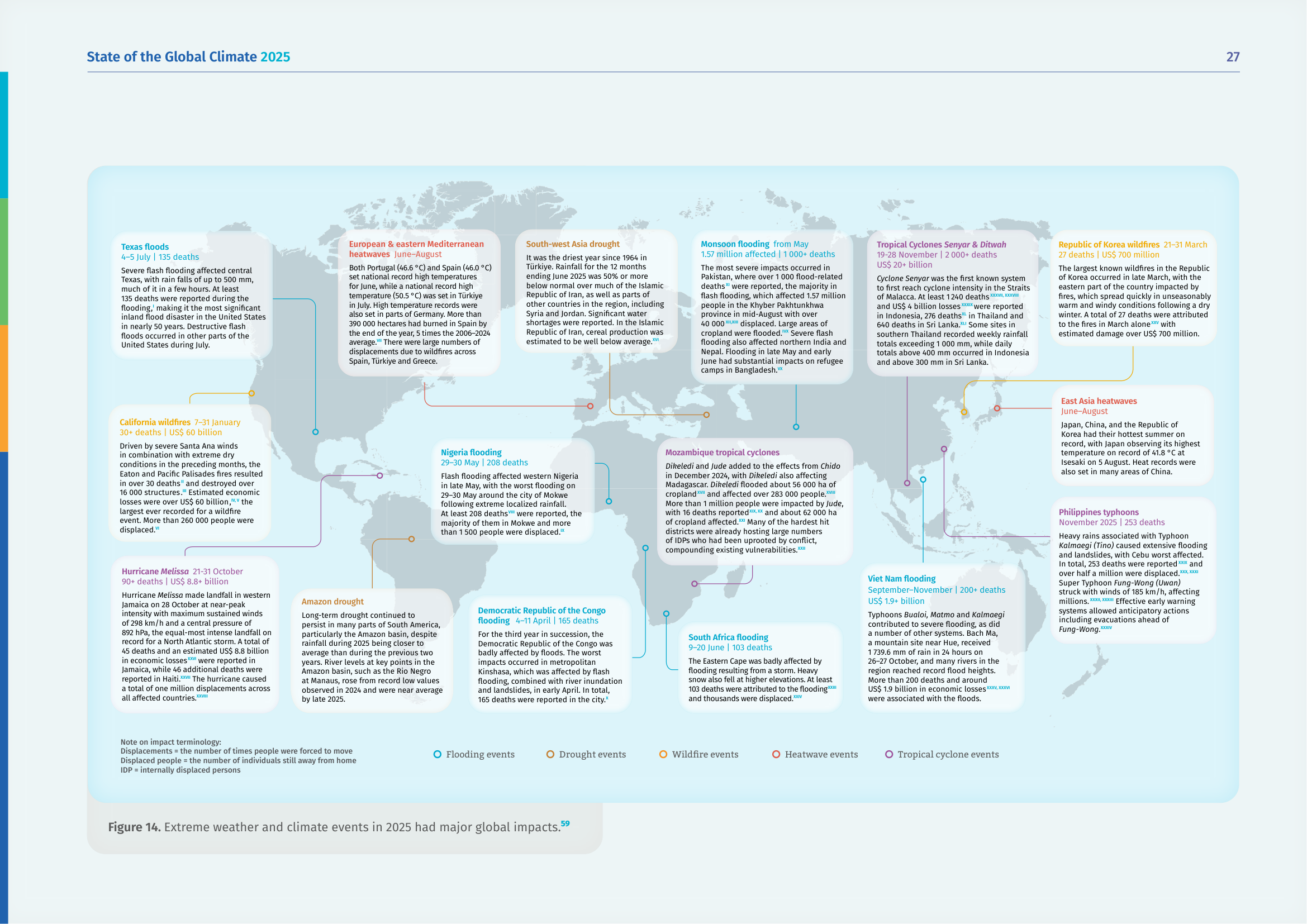
The year 2025 brought a series of devastating events across the globe:
- California wildfires (January) — 30+ deaths, over US$ 60 billion in losses, 260,000+ displaced.
- Pakistan monsoon floods — 1,000+ deaths, 1.57 million affected.
- European heatwaves — Portugal (46.6 °C in June), Spain (46.0 °C), and Türkiye (50.5 °C in July) set national records.
- Cyclone Senyar in the Indian Ocean — over 2,000 deaths.
- South-west Asia drought — Türkiye's driest year since 1964, Iran with rainfall 50% or more below normal.
Health risks: heat stress and dengue
The report devotes special attention to the health impacts of climate change. Rising temperatures are expanding the range of dengue and increasing the risk of occupational heat stress — 1.2 billion workers are exposed each year, particularly in agriculture and construction.
What does it all mean?
The WMO report does not prescribe policy actions — that is not its role. But it delivers a clear and unambiguous picture of where we stand. The planet is out of energy balance, changes are accelerating, and the consequences are being felt on every continent. The data for 2025 are not a one-off anomaly — they are part of a long-term trend that shows no sign of slowing.