
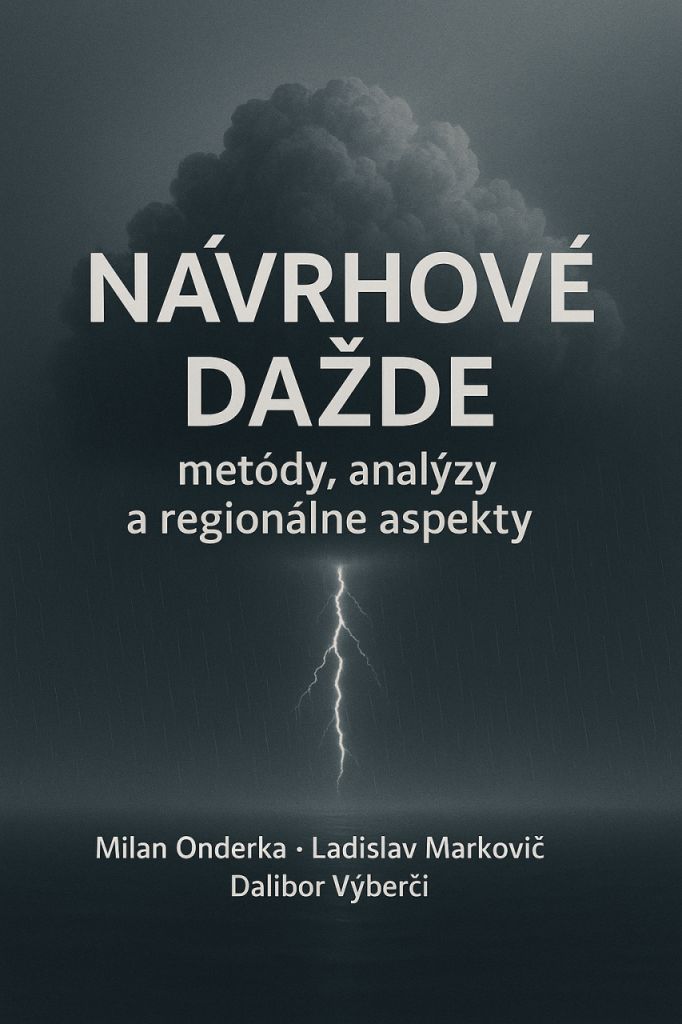
What is this book about?
In late 2025, a comprehensive publication on design rainfall was released in Slovakia — a topic of critical importance for sizing water management infrastructure, sewer networks, flood protection measures, and the increasingly relevant blue-green solutions in urban environments. Design rainfall values, i.e. extreme precipitation totals with defined return periods, serve as key inputs for engineering practice across Central Europe.
The book "Návrhové dažde: Metódy, analýzy a regionálne aspekty" (Design Rainfall: Methods, Analyses and Regional Aspects) by Milan Onderka, Ladislav Markovič and Dalibor Výberči was published by the Regional Climatological Institute in Bratislava under the CC BY-NC 4.0 licence and is freely available via Zenodo (DOI: 10.5281/zenodo.17624889). Across 253 pages, it offers a thorough treatment — from the history of rainfall measurement in Slovakia, through statistical methods of frequency analysis, to regional climate scenarios and practical applications for blue-green infrastructure.
Download Full Review (PDF) ↓A fascinating history of rainfall measurement
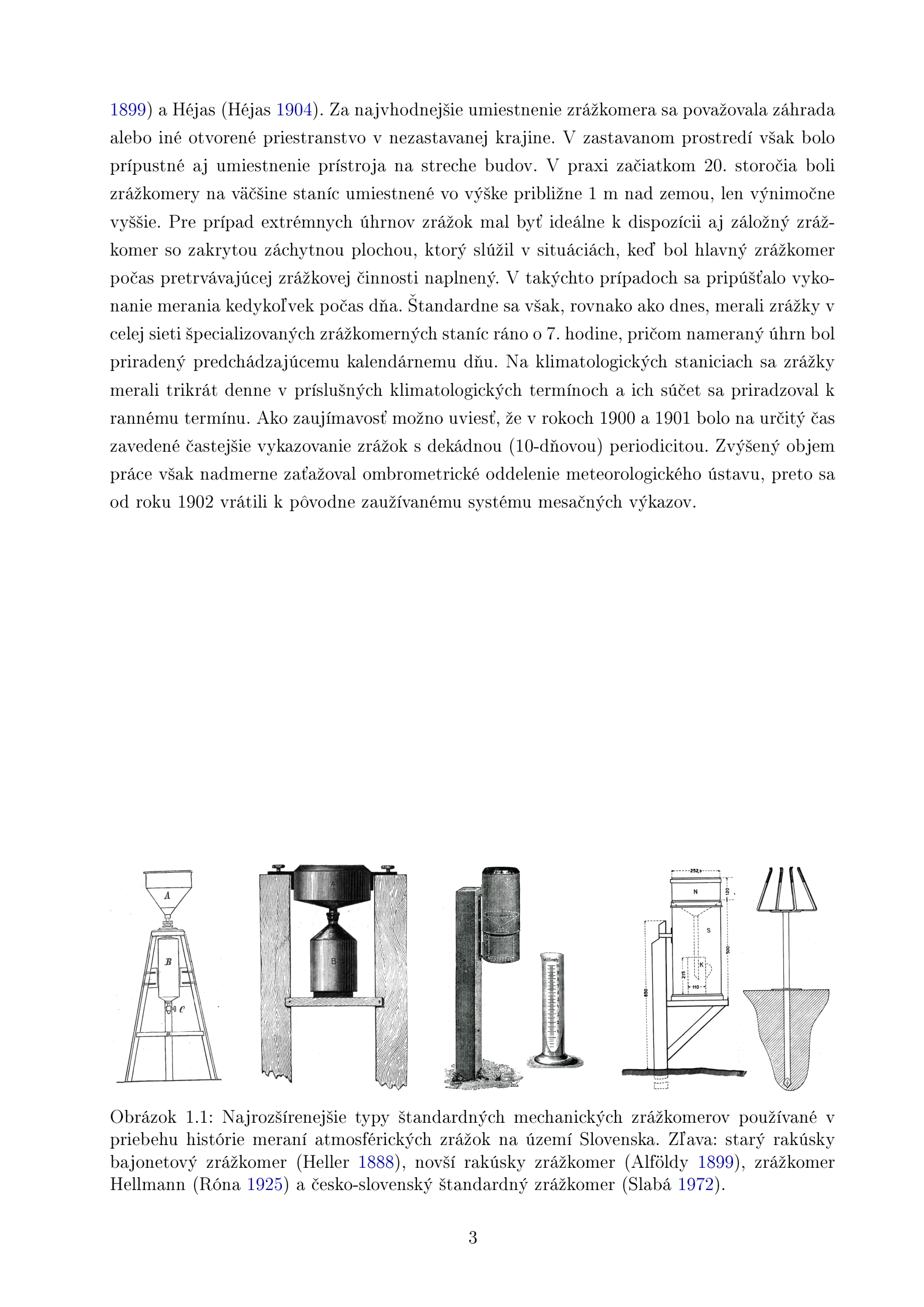
The opening chapter (by D. Výberči) is a historical gem. Readers learn that systematic rainfall measurements in present-day Slovakia date back to the mid-19th century, with the core rain gauge network built in the late 1800s as part of flood protection programmes under the Austro-Hungarian monarchy. The evolution of instruments is equally compelling — from old Austrian bayonet-type gauges through Hellmann instruments to today's automatic weather stations that form the backbone of the Slovak Hydrometeorological Institute's (SHMÚ) operational network.
Statistical foundations of extreme rainfall
Chapters 2 and 3 provide a rigorous yet accessible overview of statistical methods for extreme value analysis. The authors cover classical approaches (Gumbel, GEV, Pearson Type III), maximum likelihood estimation, L-moment methods, and Bayesian inference.
Particularly valuable is the section on the areal reduction factor (ARF), which addresses the conversion of point measurements to areal totals for catchments of various sizes. The authors derive ARFs from the COSMO-REA6 reanalysis — a methodologically innovative approach. Also noteworthy are the sections on synthetic rainfall models and the Scott-Neumann rainfall generator.
Gridded design rainfall maps from COSMO-REA6
Chapter 4 presents a rich set of gridded design rainfall maps for the entire territory of Slovakia, derived from the COSMO-REA6 reanalysis at ~6 km resolution. The maps cover various combinations of return periods (2, 5, 10, 20, 50, 100 years) and rainfall durations (from 1 hour to 72 hours). These are complemented by tabular annexes for individual municipalities.
Regional frequency analysis using L-moments
Chapters 5 and 7 are devoted to regional frequency analysis (RFA) — an approach that trades temporal information for spatial information. The authors employ L-moments and the Hosking & Wallis methodology to identify homogeneous regions and select appropriate distribution functions. Special attention is given to multi-day totals (Rx2D and Rx5D), where climatologically distinct regions of Slovakia are clearly delineated.
Climate change and extreme precipitation
Chapter 6 explores the impact of climate change on extreme precipitation using EURO-CORDEX regional climate model simulations. The authors examine projected changes in short-duration extremes under RCP4.5 and RCP8.5 scenarios, finding notable increases in extreme rainfall intensity across most of Slovakia by the end of the 21st century.
Who should read this book?
This publication is an essential reference for:
- Hydrologists and water engineers designing drainage, retention, and flood protection systems
- Urban planners implementing blue-green infrastructure solutions
- Climatologists working on extreme precipitation and regional climate projections
- Students and academics in hydrology, meteorology, and environmental engineering
- Municipal authorities developing climate adaptation strategies
Title: Návrhové dažde: Metódy, analýzy a regionálne aspekty
Authors: Onderka, M., Markovič, L., & Výberči, D.
Year: 2025
Publisher: Regionálny klimatologický inštitút, Bratislava
Pages: 253
ISBN: 978-80-975207-0-0
Licence: CC BY-NC 4.0