
Short-duration, high-intensity rainfall is among the most dangerous weather phenomena — capable of triggering flash floods, overwhelming urban drainage systems, or causing landslides within minutes. Engineers designing stormwater infrastructure rely on so-called design rainfall estimates: statistical assessments of how intense a rainfall event of a given duration can be expected at a given probability. Climate change, however, is undermining these estimates: a warmer atmosphere holds more water vapour (roughly 7% per degree Celsius, following the Clausius–Clapeyron relation), meaning that extreme rainfall events are likely to become more intense.
A team of Slovak and Polish researchers from the Slovak Hydrometeorological Institute (SHMU), the Earth Science Institute of the Slovak Academy of Sciences, the Slovak University of Technology, and the University of Agriculture in Krakow has developed a novel method that corrects systematic biases in regional climate model outputs while preserving trends in precipitation extremes — something standard correction techniques fail to do.
The problem with conventional bias correction
Regional climate models (RCMs) from the EURO-CORDEX programme simulate precipitation at a spatial resolution of approximately 12 km. However, their raw outputs contain systematic deviations (biases) compared to observations — some models underestimate rainfall intensities, others overestimate them. The most widely used correction approach, quantile mapping, adjusts the modelled distribution to match the observed one. The issue arises when the climate is changing: a transfer function derived from historical data may not hold in the future. Moreover, when the entire distribution is corrected, the result is dominated by ordinary (non-extreme) rainfall, distorting the very extremes that matter most for risk assessment.
A new approach: non-stationary GEV distribution
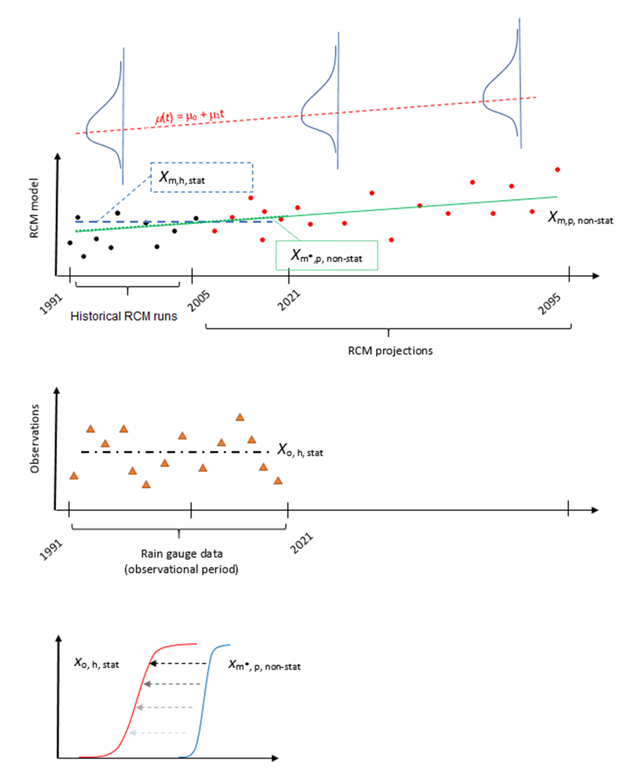
The authors propose a correction based on the Generalized Extreme Value (GEV) distribution, in which the location parameter varies linearly with time: μ(t) = μ0 + μ1 · t. This offers three key advantages:
- the correction targets the upper tail of the distribution, where extremes reside,
- it preserves the trend in projected rainfall — maintaining physically consistent Clausius–Clapeyron scaling with temperature,
- it enables quantile estimation for any future time horizon.
GEV parameters were estimated using a Bayesian approach with Markov Chain Monte Carlo (MCMC) sampling, a method that is robust even for relatively short time series.
Data and models
The analysis used:
- observations from 75 rain gauges across Slovakia for the period 1991–2021 (minute-resolution data from both automatic and mechanical instruments),
- four EURO-CORDEX regional climate models (ALADIN63, RCA4, HIRHAM5, RACMO22E), all driven by the HadGEM2-ES global model,
- the RCP8.5 scenario (the most pessimistic pathway, but retrospectively the closest match to actual cumulative emissions over 2005–2020).
Three-hour quantiles from the RCMs were subsequently downscaled to shorter durations (5–180 minutes) using locally derived empirical scaling functions based on observed data.
Key findings
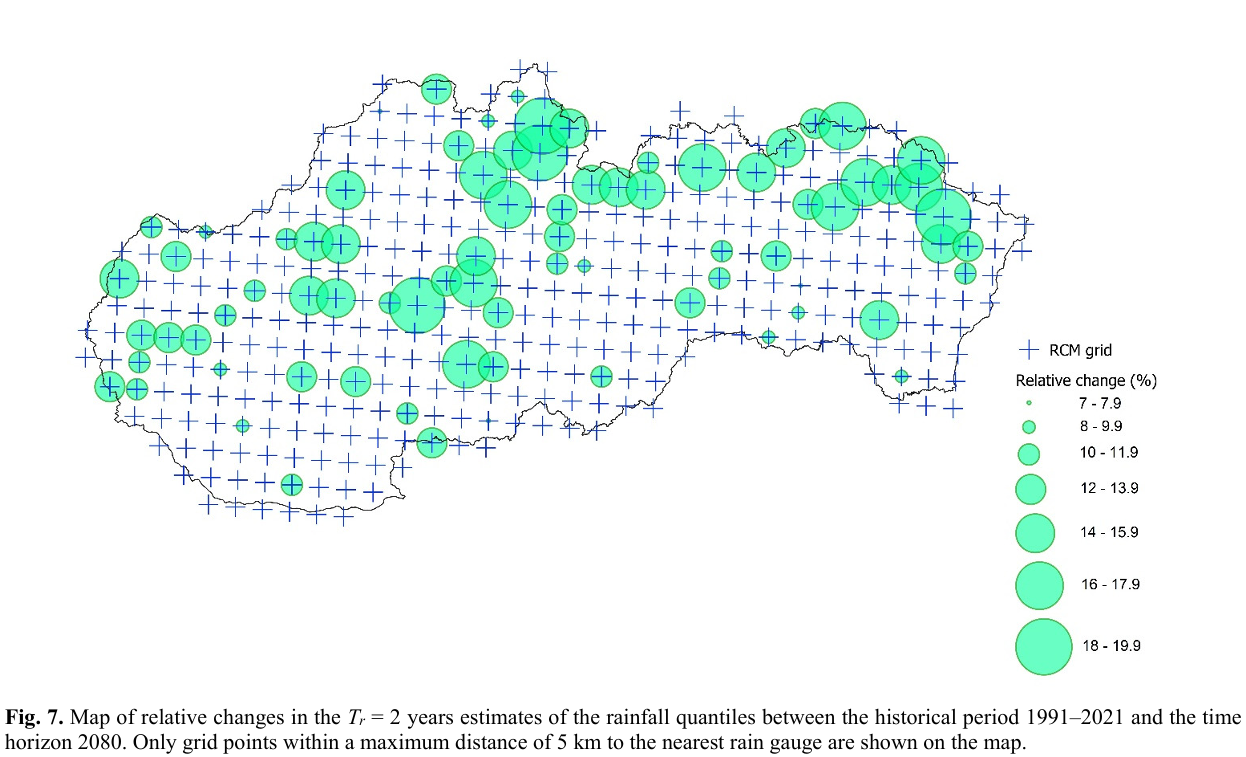
The mean relative change in rainfall quantiles between the 1991–2021 baseline and the 2080 horizon:
| Return period | Mean change | Std. deviation |
|---|---|---|
| 2 years | +13.5% | 2.9% |
| 5 years | +9.7% | 2.0% |
| 10 years | +8.0% | 1.6% |
| 50 years | +5.5% | 1.1% |
| 100 years | +4.8% | 1.0% |
Notable findings:
- The relative change is largest for short return periods (2 years: ~10–19%) and decreases toward longer ones.
- The most pronounced increases were found in mountainous areas of northern and north-eastern Slovakia.
- The results are physically consistent with Clausius–Clapeyron scaling of precipitation with temperature.
Why does it matter?
This is the first study of its kind for Slovakia that estimates future changes in sub-daily (short-duration) rainfall extremes using regional climate models. Sub-hourly rainfall intensities are critical for hydrological modelling in urban areas and small catchments. A 5–14% increase in design rainfall may not sound dramatic, but for urban drainage dimensioning it can mean the difference between a manageable situation and a flash flood.
Based on: Onderka, M., Pecho, J., Szolgay, J., Kohnová, S., Garaj, M., Mikulová, K., Varšová, S., Lukasová, V., Výleta, R., Rutkowska, A. (2024). Applying a time-varying GEV distribution to correct bias in rainfall quantiles derived from regional climate models. J. Hydrol. Hydromech., 72(4), 499–512. DOI: 10.2478/johh-2024-0025 | SAV Repository